A car's suspensions job is to maximize the friction between the tyres (tires) and the road surface, through its contact patch. To provide steering stability with good handling and to ensure the comfort of the passengers (in road cars). While the aim of a car manufacturer will be a comfy ride for passengers, this will not reap the ultimate reward for the driver's car, this requires agile handling.
If a road surface were perfectly flat and had no irregularities in it, then suspensions would not be required to a certain extent. But roads are far from flat, even freshly paved motorways (highways) have subtle imperfections that can interact with the wheels. It's these imperfections that apply forces to the wheels and suspension components and causes handling imbalances in compromised set ups.
Suspension is also used to control the vehicles body weight, both sprung and unsprung mass. Through the corners, under braking and acceleration. If you had two identical car in terms of weight, engine power, aerodynamics and tyres. The suspension design and set-up will be the difference between which one would be most competitive. Suspension systems help to control the movement of the car's mass and load transfer rates and this has a direct effect on the ability of the tyres to work in optimum conditions.
If one tyre is over loaded compared to another on the same axle, this will result in an handling imbalance. If this happens when braking, one front tyre could lock up for example, resulting in reduced braking efficiency. If one tyre is over loaded on the rear axle, this could result in wheel-spin (on rear wheel drive cars), reducing acceleration capacity. If the outside tyre is overloaded when cornering, this could result in a reduction in cornering force and increases understeer or oversteer.
As we can see the suspension is all about helping the tyre to keep in the best contact with the road surface as well as controlling the weight of the vehicle. Overloaded tyres will not only reduce acceleration, braking and cornering capacity, but will increase their heat levels as they are being over worked. This will have a direct effect on the tyres wear rates and will further add to the tyres lack of performance.
Over the Years with ongoing technological developments, manufactures have produced a multitude of difference suspension designs and this is ever evolving.
Different Suspension Types
We have covered the various suspension systems on there own specific sections. Although there has been a number of different system designs over the year´s, there are some fundamental components which are needed for an effective suspension system. How the springs and dampers are configured depends on the suspension set.
1. Springs
These are essentially coils of metal (other materials can be used), their job is to support the vehicles unsprung mass and aid in its control in a dynamic nature during different directional loads. Springs act to absorb road irregularities, by letting the wheels move up and down, on a vertical movement (bump and rebound). If only springs were fitted to a car, the car would bounce up and down the road, until the energy had been dissipated. If more bumps were encountered while the springs were still compressing and expanding, this would add further energy and more oscillation would occur. Normally mounted to the unsprung mass at the bottom and sprung mass at the top of the spring in traditional car design. Three factors govern the the success of the unit in question:
Once we have these we can then only work out the spring rate at this is the solution and not the starting point- with sprung weight and unsprung weight being added to the equation.
2. Dampers
This is a device to control and limit the amount of force acting on the suspension system through the springs. Springs as mentioned above would keep bouncing up and down unless the energy had been absorbed, dampers control the upward and downwards movements of the wheels and springs (bump and rebound). Depending on the design, dampers are normally oil filled cylindrical chambers, with a piston inside. The oil inside the unit moves within channels and provides resistance, enabling it to control the springs in motion.
3. Improving Suspension
Chassis and handling suspension upgrades will improve acceleration, braking and cornering abilities by maximising traction. There is no point in having the most powerful car, without the platform to control and use the power through the wheels. It is always a balancing act between power and handling with suspension parts.
With the right suspension upgrades, we can increase torsional stiffness or lower the car's height to achieve a more driver focused compromise. Careful selection of the right products and settings need to be taken into account as minor changes can causes major handling extremes.
More in-depth information is covered in Suspension Upgrades and Suspension Tuning sections.
McPherson Strut Suspension
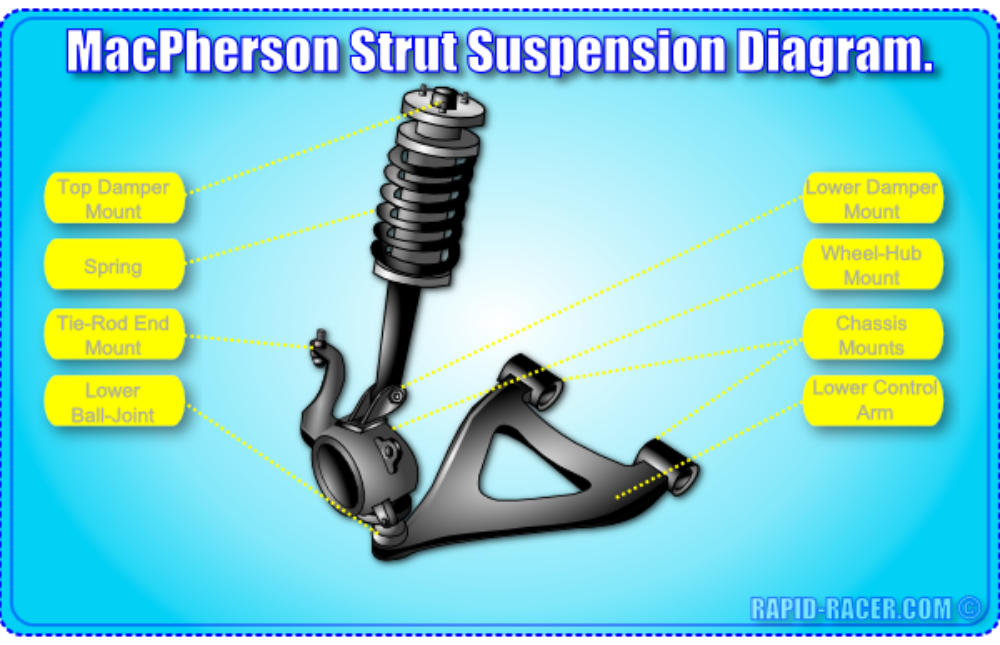
The McPherson strut is a type of car suspension system commonly used in many modern motor vehicles. This includes both front and rear suspensions set ups, but usually is located at the front of the car. It provides a steering pivot (known as a kingpin) as well as a suspension mountings for the wheel.
Rear positioned struts are also in use but these are less common. In 1957 Colin Chapman of Lotus applied the design to the rear suspension of the Lotus Elite. As a result, McPherson strut suspension located at the rear of an auto-mobile, is commonly called Chapman struts. To be really successful, the McPherson strut required the introduction of the uni-body (or monocoque) construction chassis. This is because it needs a substantial vertical space and a strong top mount, which uni-bodies can provide and also by distributing stresses, greatly increases the suspension's performance potential.
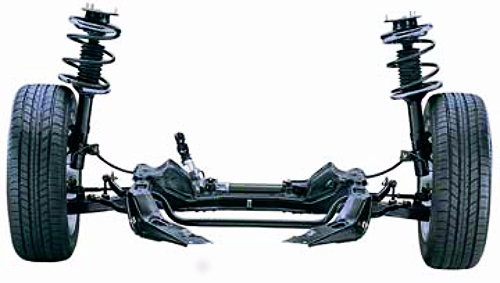
The McPherson strut normally also has a steering arm built into the lower inner portion. This assembly is extremely simple and can be pre manufactured into a unit at the assembly line. By removing the upper control arm, it allows for more width in the engine bay, aiding in any maintenance work or engine design requirements.
Especially useful for smaller cars, particularly with transverse-mounted engines such as FF (front wheel) drive designed vehicles. Further simplification is possible by substituting an anti-roll bar (torsion bar) for a radius arm. It offers an easy method to set suspension geometry. Ultimately making the production overheads more cost effective and making this a very common design set up in today's marketplace.
Although the McPherson Strut is a simple design and has low manufacturing cost, there are always compromises and a few disadvantages associated with the suspension design. The quality of ride it produces and the handling of the car may suffer or be less effective then other set ups with offer more suspension geometry adjustments (double wishbone suspension).
Geometric analysis has shown that McPherson Strut design can not allow vertical movement of the wheel without some degree of either camber angle change, sideways movement (or both). Double wishbone suspension is favoured for Motorsport applications, due to this fact.
With the McPherson Strut set up, the wheel tends to lean with the body, leading to understeer under extreme cornering. In a FF designed car, this adds to the already natural tendency for understeer and is far from ideal. The ideal situation would be neutral handling, so this might benefit other drive line set ups.
Another disadvantage of the design is that it tends to transmit noise and vibration from the road directly into the body shell of the car. This results in higher road noise levels and sometimes a harsh feeling to the handling compared to a double wishbones set up. This results in manufacturer's adding extra noise insulation in a bid to reduce the the negative effects, which can lead to some weight gains as expected. Further reducing the performance potential.
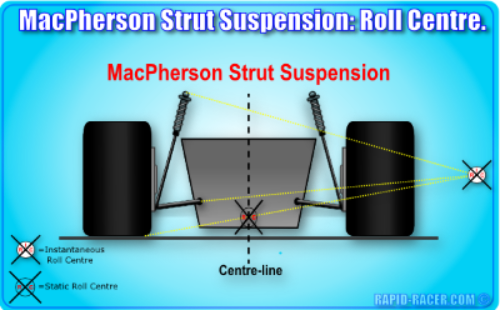
Mcpherson Strut Suspension: Roll Centre
Low and controlled roll centre compared to some designs, but this not the best in the class. The overall design may struggle to fit into extremely low car chassis constructions, also the wheel angle is almost the same as the roll angle- resulting in high braking force wanting to snap the component in half. Another downside is that camber and caster adjustments are not easy and may require additional modifications to enable this.
Double Wishbone Suspension
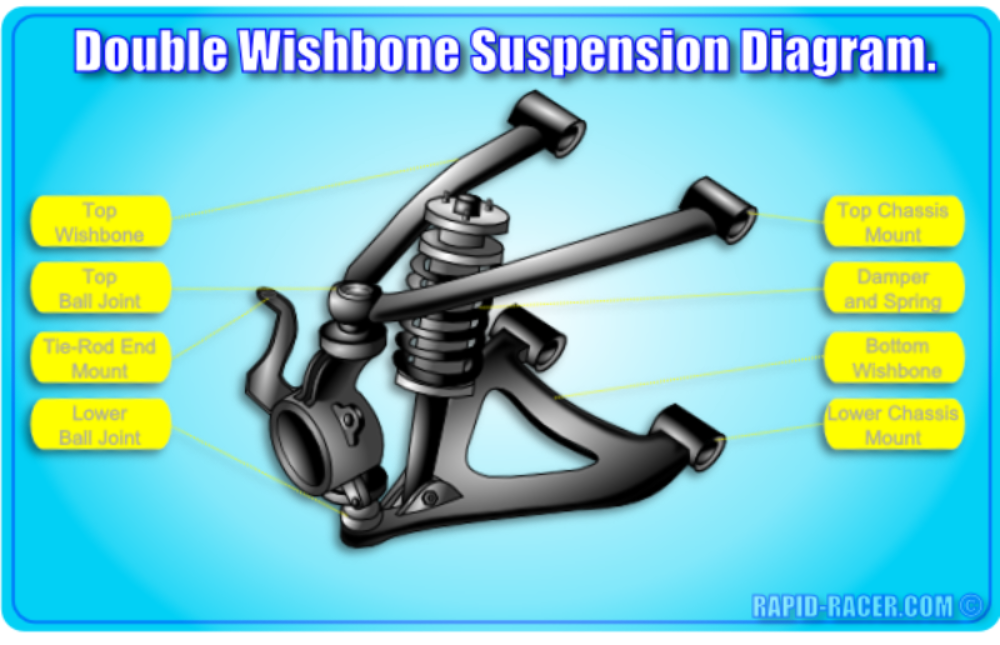
In Motorsports the application of the double wishbone suspension set up, is the preferred system and this is used in F1 for example. This is partially because it allows the engineers more freedom to choose camber levels and roll centre settings. Which ultimately will affect the car's handling in certain situations and could affect lap times and the handling effectiveness of the vehicle.
Each wishbone (or A arm) has two mounting points to the car's chassis and one joint at the knuckle (ball joint connection), which is connected to the wheel hub. The shock absorbers and coil springs, mount to the wishbones to control vertical movement and are located inboard with pushrod and pullrod suspension designs (open wheel racing cars). Or can be located at the wheel hubs depending on the design specifications (closed wheel racing cars).
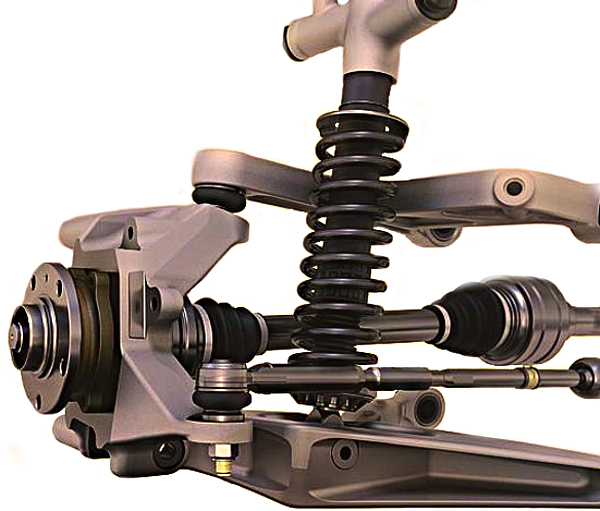
The main advantages of the double wishbone suspension set up is that it is reasonably easy to work out the effects of the moving joints. This allows engineers to easily tune the kinematic of the set up to optimise wheel motion. In Motorsports where a tenth of a second a lap can mean the difference between winning and losing, having a suspension set up which is easily adjustable, will yield greater performance for competitiveness.
Double wishbone suspension design is more effective in working out the loads that different parts of the suspension are subjected to, which could mean continued development and progression of lightweight parts especially in a racing environment. This could result in individual component evolution in stead of whole suspension revisions.
Double wishbone suspension provides increasing levels of negative camber, throughout the whole suspension motion including full jounce travel. Unlike the McPherson strut design which provides negative camber gains, only at the beginning of jounce travel and then reverses into a positive camber gains at high jounce level levels. Positive camber reduces tyre CF levels (coefficient of friction), decreasing cornering grip.
The Double Wishbone design has disadvantages as well, in that it is slightly more complex than other systems like a McPherson strut and will be more expensive to manufacture and produce. There will be the slight increase in weight, which can be offset with the use of composites. The suspension system will also need more precise tuning and configuration to yield the best performance gains. If you looking for the ultimate suspension design with the greatest performance, double wishbone suspension is the only choice.
1. Double Wishbone Suspension Layouts
Equal Length and Parallel Links
When double wishbone suspension is configured with equal length and parallel wishbones (A arms), we lack any negative camber increase during bump. For tyres to be effective in cornering grip generation, negative camber is required for maximum traction on the outside tyre. This is one of the funder mental problems with this type of design.
There is also the problem of the increase in track width, when the chassis rolls during cornering loads, both the wheel and tyre are in direct coalition to this movement. The outside wheel is also subjected to positive camber increase, which further hinder cornering abilities. The wider the tyre width, the larger this effect has on positive camber increases.
One way in which engineers tried to tackle this problem was by increasing the wishbone lengths, closer to the vehicle centreline and this reduces the effects some what. But due to the equal lengths of the wishbones, we can never get away from this issue.
Unequal Length and Parallel Links
By changing the top wishbone length in double wishbone design, we have a way in which to tackle the problems associated in equal length design. The top wishbone is shortened and we now have negative camber generated during bump motion. Also we have either negative or positive camber levels generated in rebound depending on system settings.
The ration between the top and lower wishbones as a direct effect on negative camber generation, with the shorter the top wishbone length, the greater the effect. Also we have a reduction in track length, which was another issue with equal length wishbones, with care this can be negligible.
When the chassis rolls during cornering forces, the outside tyre has now reduced positive camber, which is a good thing, but we now also have negative camber increase on the inside tyre, which is a bad thing. Ultimately as the outside wheels does the majority of the cornering, we can accept this compromise, as we still get a performance advantage over equal length double wishbone designs.
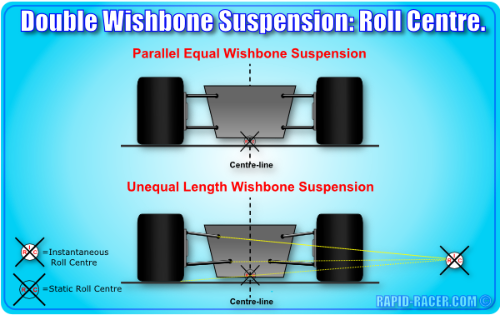
2. Double Wishbone Suspension: Roll Centre
Equal and Parallel
The roll centre is extremely low, which is good for the centre-of-gravity and handling- the downside is that the roll angle results in positive camber, the opposite of want we really want.
Unequal and Parallel
Again extremely low roll centre, with great versatility- with the ability to do what ever the engineer requires it to- the downside is that this is not all at the same time.
Pushrod and Pullrod Suspension
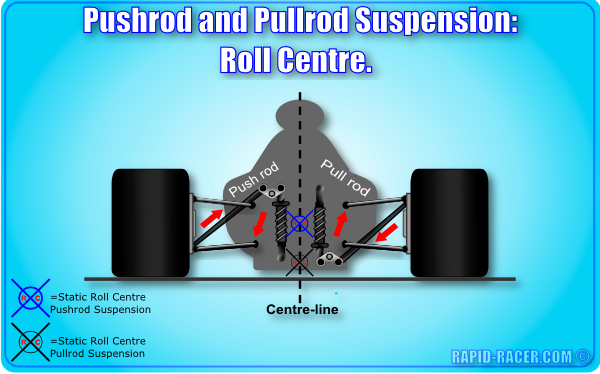
Pushrod suspension can be viewed as a evolution of the double wishbone suspension configurations, in that the springs and dampers are relocated away form the hub and wheels. This is not a new technology and as it has been in race series like F1 since 1984.
The actual springs and dampers are normally relocated inboard in open wheel racecars and are connected via linkages and a pushrod or pull rod lever. This has many benefits compared to traditional design for open wheel racecars, the advantages of closed wheel racecars will not be as rewarding. This is due to the already high pressures present in wheel arches.
Pushrod and Pullrod Suspension Advantages
While pushrod and pullrod suspension design are similar in nature, we could view then as opposite to each other in configuration. Both designs share the same components and the selection process will normally come down to the overall packaging needs and weight distribution requirements, rather than purely on the performance gains. There is no clear advantage of pullrod or pullrod design, as both produce similar handling characteristics.
Pushrod and Pullrod Suspension: Roll Centres
As we can see from the diagram below, Pushrod has a slightly higher roll centre than the Pullrod designs. Overall this is an evolution of the double wishbone suspension which we have covered already and will not be the main advantages of this design.
Anti-Dive and Anti-Squat Suspension
Anti-dive and anti-squat suspension systems have come in and out of designers and engineers attention over the Years. Both systems are used to help control or minimise longitudinal vehicle load transfer, in an aid to either retain suspension compliance, or improve aerodynamic stability.
1. Anti-Dive
Used to prevent the front of the car making contact with the ground and bottoming out, under extreme braking conditions. Also if frontal weight load transfer is too extreme, this results in over-loaded front tyres, which can exceed traction levels and could result in brakes locking up. This could be combined with more understeer and increased tyre wear rates at the front of the vehicle.
The overall aerodynamic balance can also be effected, as the car´s aerodynamic devices will increase it´s angle-of-attack, as the vehicle experiences extreme forward weight transfer. This may not be a bad thing in some situations, depending on the aerodynamic set up, as this could further enhance braking efficiency. But too much angle of attack can have an effect on wing stall, which will greatly affect down force generation capabilities and and associated drag penalties. If the aerodynamic wings stall, the car will have reduced braking and cornering capacities.
2. Anti-Squat
Used to prevent the rear of the car from bottoming out under extreme acceleration forces. Also helping to keep the rear suspension setting in check, especially camber angles. If rearward weight transfer is too extreme, this can result in over-loaded rear tyres. Again, this can lead to exceeded traction levels, with increased tendency to wheel spin on acceleration and corner exits. This could result in more oversteer and increased tyre wear rates at the rear of the vehicle.
Aerodynamic balance can be effected, with overall aerodynamic devices decreasing their angle of attack in extreme situations. Also an important point to remember, when the rear end is subjected to squat, the front end could be subjected to lift. This follows the lever effect of the rear weight, raising the front end, if enough air is allowed to get under the front wing, bad things can happen- which could include lift, especially dangerous if this happens on the crest of a hill.
3. How Does Anti-dive and Anti-squat Works?
By tilting the front and rear suspension mount points, by a couple of degrees towards the vehicles centre of gravity, anti-dive and anti-squat characteristics can be achieved. It is important to realise that the suspension set up is geometric in its design and does not rely on spring and damper adjustments to achieve this affect.
Care must be taken when deploying just anti-dive (front) or anti-squat (rear) on just one end of the vehicle. This is because the same set up to provide resistance to longitudinal weight transfer in one direction, can also have the reverse effect and act in aiding weight transfer in the opposite direction. Effectively improving one way weight transfer, but with negative effects in the other direction.
While anti-dive and anti-squat suspension systems were originally designed to just keep the suspension in check. In modern times with the further performance potential of effective aerodynamics, this design has been deployed solely for this purpose in the pursuit for balance.
Ideally maximum aerodynamic efficiency is achieved through a stable chassis. With out any help from other systems like dynamic down force or active suspension systems, anti-dive and anti-squat may help to achieve this.
Active Suspension
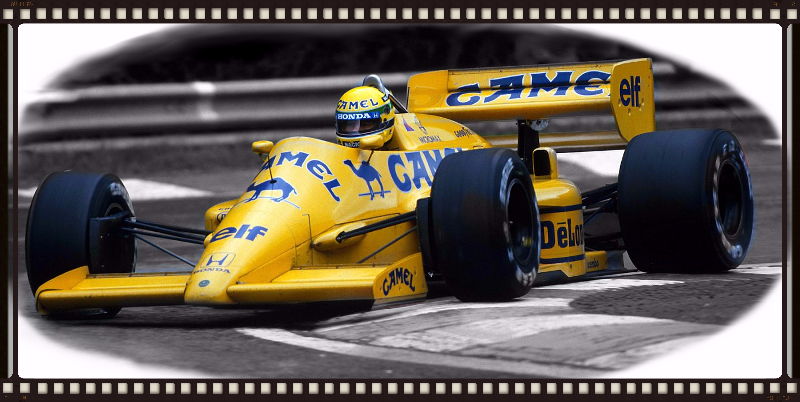
The world's first computer controlled suspension system (active suspension), was deployed by Lotus on their 1983 92 Grand Prix car, at Long Beach. Active suspension can improve the ride, stability, steering and road holding capabilities of even the best of current suspension systems. Active suspension especially on rough or off road applications will come into its own. In road car applications, you could have a car with jackal and Hyde characteristics. You could transform a soft and comfy ride for commuting, with a press of a bottom into a a track focused racer.
The overall system is filled with oil in a hydraulic damper, which is fed by a oil pump with some 3,000 psi of pressure. The system main contain springs to support sprung mass when stationary, this also takes some of the strain of the oil pump, there is also geometrically planned linkages. This active suspension system has multiple accelerators (sensors), a micro processor (transmits and receives data) and control CPU (brain). This measures what is happening with the suspension system and can make up to 250 million decisions over single Grand Prix.
Active Suspension Processes
Analyse: It is possible for the active suspension system to make detailed records of all of the systems operations during a race, including forces exerted and adjustments made over a given time period.
Control: The overall system can control damping, both bump and rebound, roll of the sprung and unsprung mass.
Optimise: After the analysing phase of data recording, it is possible to fine tune the brain to further improve the suspension performance levels, by previewing decisions which were made.
Active Suspension Advantages
With active suspension systems in place, it was possible to essentially get rid of traditional dampers, anti-roll bars and springs if required. The system could also act as a ant-dive and anti-squat system. Having a extremely stable chassis under different road conditions further enhanced the aerodynamic efficiency of the car. There was no bottoming out under extreme load forces and bad road conditions. Chassis balance was greatly improved and the tyres did not overload as much.
Active Suspension Overview
Trailing Arm Suspension
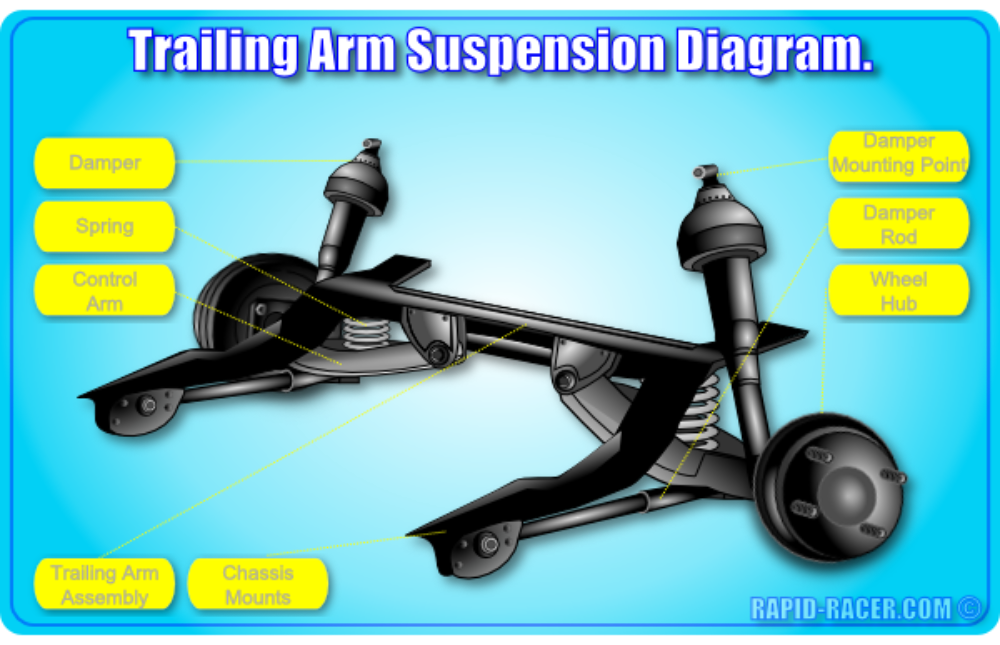
Trailing-arm suspension is a design in which one or more arms are connected between the rear axle and the chassis, toward the front of the vehicle, creating a pivot point. This allows the rear to move up and down. Commonly found in Pre 1990's application, when it was then mostly replaced by multi-linkage suspension.
Viewed as an older suspension technology set up, trailing arm design does take up a lot of space in the rear chassis area compared to other modern systems. A good place to look is the original VW Beetle´s front suspension set up, which uses a double trailing arm suspension set up.
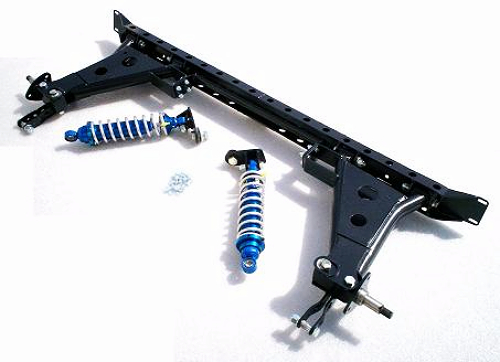
Semi-trailing arm suspension is a supple independent rear suspension system for cars, where each wheel hub is located only by a large, roughly triangular arm that pivots at two points. Viewed from the top, the line formed by the two pivots is somewhere between parallel and perpendicular to the car's longitudinal axis; it is generally parallel to the ground.
Trailing-arm and Multi-link suspension designs are much more commonly used for the rear wheels of a vehicle, where they can allow for a flatter floor and more cargo room especially in commercial vehicles. Many small, front-wheel drive vehicles feature a McPherson strut front suspension and trailing-arm rear axle combination.
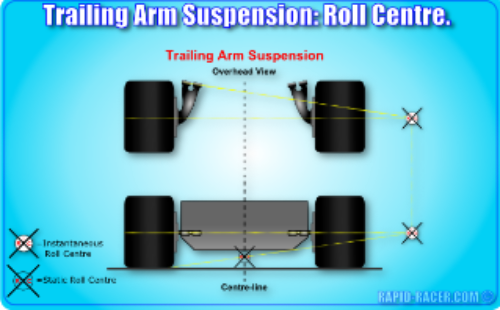
Trailing Arm Suspension: Roll Centre
The biggest advantage of this design is that the stationary roll is low to the ground- the major big disadvantage is that roll angles from one wheel are transmitted to the other- so the side in roll means both sides are in roll.
Leaf Spring Suspension
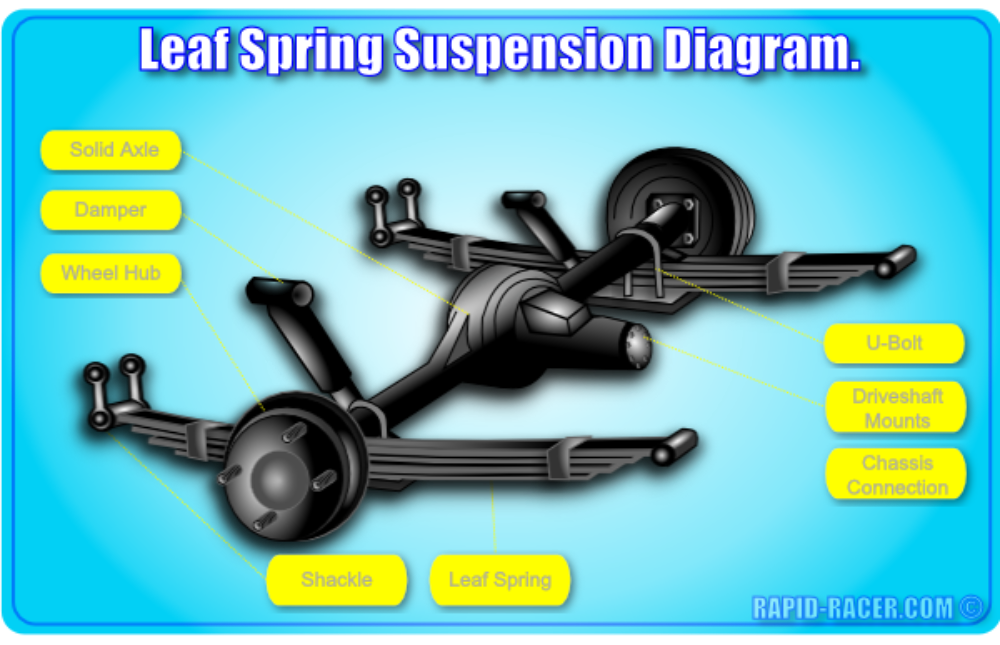
Leaf springs suspension was common right up to the 1970´s in Europe, Japan and up until the late 1970's in The United States of America. When the implementation to front wheel drive and more sophisticated suspension designs were implemented, this convinced car manufacturers to use more advanced suspension systems like the coil springs instead. Leaf springs are still used in heavy commercial vehicles such as vans and trucks, SUV´s, and railway carriages. As they are cheap to manufacture and have excellent load carrying capacities.
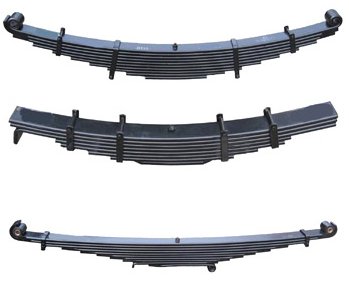
The main advantages are for heavy vehicles is they spread the load more widely over the vehicle's chassis, where as coil springs transfer it to a single point. This reduces the pressure and structural loads which results in a more robust design.
Unlike coil springs, leaf springs also can be located at rear axle, eliminating the need for trailing arms and a Pan-hard rod, thereby saving cost and weight in a simple live axle rear suspension.
Parabolic Springs
Also with more recent technological developments of the parabolic leaf spring, the design is characterised by fewer leaves which thickness width varies from centre to ends, following a parabolic curve. With this design, inter-leaf friction is unwanted and there is only contact between the springs at the ends and at the centre where the axle is connected.
Spacers prevent contact at other points through out the design. Apart from a weight saving advantages of this design, the other benefits of parabolic springs is their greater flexibility, which means vehicle ride quality that is comparable that of coil springs.
But there is a trade-off in the form of reduced load carrying capabilities, so this will only be used in appropriate applications. Characteristic of the parabolic springs include better ride quality and not a "harsh" as conventional "multi-leaf springs".
This design is widely used on buses for better comfort of the passenger on board, where comfort takes a higher priority over load capacity. A further development by the British GKN company and by Chevrolet with the Corvette amongst others, is the move to composite plastic leaf springs.
This technology is limited in its performance potential, especially compared to more advanced suspension system.
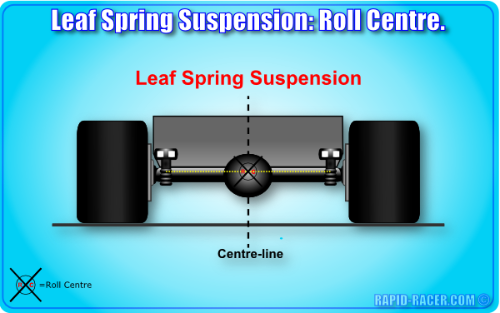
Leaf Spring Suspension: Roll Centre
As with most solid axle designs, normally the roll centre is located in the middle of the differential- but this is not always the case. The wheel angle is mostly vertical, in most racing application the roll center is too high and the overall weight to great to be an effective package in modern racing.
Coil Spring Suspension
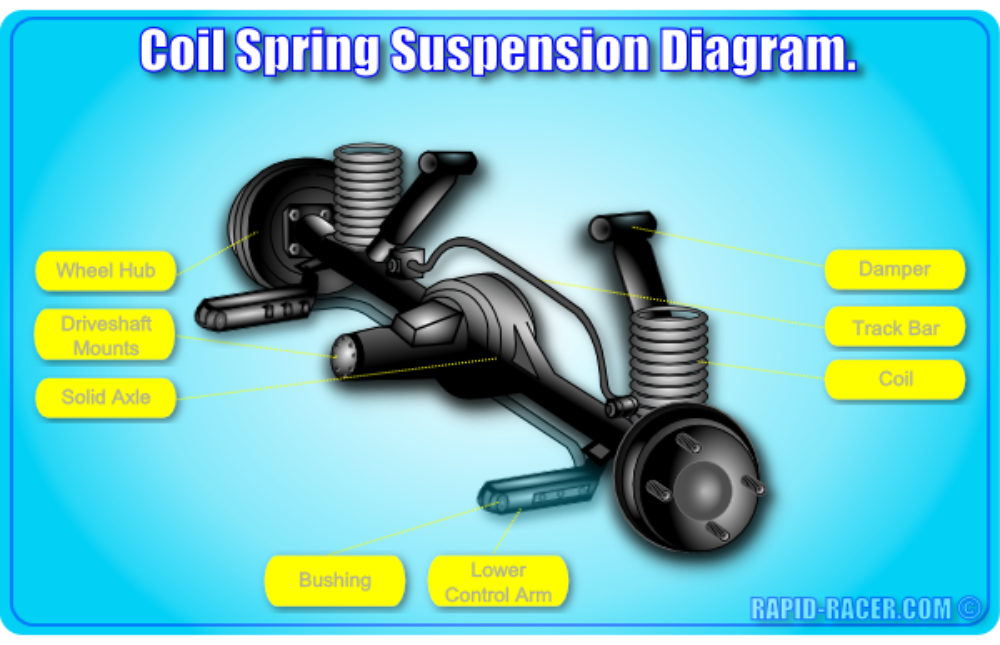
This is another variation and a update on the leaf spring and solid axle coil spring suspension design. This Coil spring concepts is in theory very similar, but the main difference is that the leaf springs have been removed in favour of either coil-overs and spring and shock combinations.
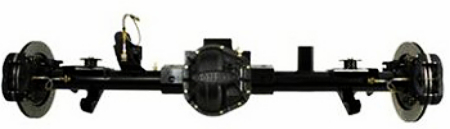
Due to that fact that the leaf springs have been disposed of, the axle will now need lateral support from control arms. One is located each end and attached to the chassis and the other to the axle. There can be variations in the different layouts, but fundamentally this design is deemed as older technology. From a performance point of view, effect handling characteristics can be quite limited in it's application.
Beam Axle Suspension

Beam Axel suspension set ups are normally deployed in FF (front wheel drive) drive cars and it is a relatively simple designed system. The so called beam runs across and under the car's width, with the rear wheels attached to either end.
A spring and shock combination unit or indeed struts are bolted to either end and normally located in the car body or chassis. The beam has two integrated trailing arms built in in place of the separate control arms, which are found on solid-axle coil spring suspension systems. Again there are other variations on the beam axle design and they can have either separate springs and shocks, or the combined coil-overs.
Pan-hard Rod
One main difference with other designs is the track bar (pan-hard rod). Basically a diagonal bar which runs from one end of the beam to another point, either in front of the opposite control arm or diagonally up to the top of the opposite spring mount. This bar's job is to try and stop side to side motion, in the beam and help make the system more efficient.
Twist Axle
Another variation is the twist axle which is identical with the exception of the pan-hard rod. In this design the axle is designed to twist slightly, which in effect creates a semi-independent system and a bump on one wheel is partially absorbed by the twisting action of this beam design.
From a Performance point of view, Beam Suspension is not the optimum choice for performance potential. Due to its construction, this design has a large unsprung weight compared to other suspension set ups. When the suspension is under load, each individual wheel can not operated independently. Similar to a car with a too stiff or thick anti-roll bar (sway bar) fitted at the front of the vehicle. Anything which affects one wheel, will transfer to the other, which will hinder handling balance.
This transfer of loads between wheels is far from ideal for a turn in on a Racetrack, also another disadvantage is the lack of Negative Camber under cornering loads load. This results in poor handling compared to other suspension set ups. Normally when the suspension is compressed, Negative Camber will result, aiding turn in response for the outside tyre.
Beam Axle design does have some advantages in off Road applications, also due to the lay out lends itself well for Pick Ups and Van applications, due the way it can deal with varied load weights. Another good point is the impact it has on internal vehicle space, due to it's compact suspension design and dimensions, it will increase load carrying capacities.
Spring Materials
Suspension in its fundamental concept revolves around it either hanging or riding on the body of the vehicle and is designed to give flexibility in order to keep the wheels in contact with the ground at all times. Constant different configurations and designs have been explored over the Years especially with spring materials, we will run through some of the different types.
Metal
We have covered this in the leaf spring and coil spring selection- early designs used iron and then steel in order to provide strong and relatively cheap, but heavy suspension springs. Another disadvantage is the ability to provide a compact design and low centre of gravity- so this medium was really stop being deployed for racing after the 1960's and the development of other preferred materials. Torsion bars would also come under this category as they were essentially simple rods of steel tube or bars- like a coil spring before it had been coiled. Mounted and supported at either end, the unit would twist under strain and could be viewed as even easier to manufacture than leaf spring designs, but can not achieve the various leaf spring positioning. It does however provide a more predictable behaviour under strain. Last of the list is the now universal coil spring, which undoubted is the favoured choice of modern racing applications. Advantages include light weight, compact in design, variable in terms of spring strength, rate, diameter and even length. Friction free, with a low centre of gravity possible, no wonder this has been the modern solution for both road and race applications in modern times.
Rubber
On the face of it rubber is an extremely good material for the spring requirements, as it is compact, light weight, inexpensive and controllable with the right technical knowledge. It is possible to place it exactly where is required, even more so than a coil installation. It has been deployed in many racing applications and was used in the original mini production cars- even the rate and ride height can be easily adjusted. Why is it that we have not seen this medium prosper in modern day applications, the simplest answer is lack of top level development and the success of the coil.
Air
Used all over the world in commercial applications, air seems like another great contender for your springing needs, its free of charge as it is all around us, has a rising rate which is natural and even deployed for low riders- so it must be great for Motorsports applications right? Well sadly this is not the case, the air needs to be topped up to keep the unit functioning at optimum levels and also with repeated use you generate heat. Also we have the issue of dead weight needed to be added to the design for air compressors, piping, seals, pistons and operating rods- let alone the power needed to run them. This all leads to more complexity and cost over traditional approaches, this is not saying future active suspension systems might find this of use for passenger cars.
Oil
Used in the World's first Active Suspension Computer Controlled System for Motorsport applications- Lotus used oil for both the damping and spring in this dominating design. Deployed on the Lotus 1987 99T Grand Prix Car, this was the ultimate in suspension achievements and we covered this in its ow section previously.
