Aerodynamic Upgrades are one of the key area in Race car development which can easily win a race, with direct effect on the top speeds and cornering. Depending on the required goals of the car in question, we can either reduce drag and increase top speed, increase down force and drag levels for cornering speeds, or aim for a balance between the two.
Ultimately it all comes down to lap times and the track layout, this should determine the way to go on aerodynamic set-ups. In order to be able to adjust the aerodynamic profile of your car, unless you already have aerodynamic upgrades fitted- you are pretty much stuck with your current configuration.
Aerodynamic upgrades come in many different forms and have evolved mostly from the early days of motor racing with streamline design in the very beginning. This was in an attempt to increase overall top speeds and the aeronautical world played a big impact on design directions. As engineers and designers slowly gained more knowledge on the subject, discoveries like negative lift (down force) and ground effects, deployed by the likes of Lotus and Colin Chapman, were effectively used to win many F1 races in the 1960´s.
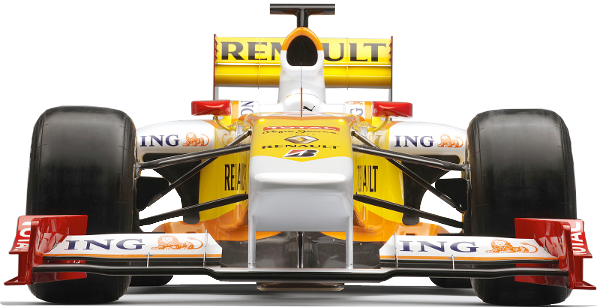
These technologies dramatically changed the face of racing forever and aerodynamic upgrades are still at the very top of Motorsports team's objectives and abilities to win races. Various components are used to realise this and can include for example: Air Dams, Front Splitters, Aerodynamic Under-bodies, Rear Diffusers and Wings.
These devices and many others are used to make race and road cars increase their aerodynamic abilities, this in turn helps to keep the tyres planted on the tarmac and maximise traction.
There are some main differences between “open wheel” (F1 for example) and “closed wheel” design and some components will not be applicable for both specifications. But they do share the common goal to increase down force levels for the minimal amount of drag, for the chosen track requirements. With out drag, down force is not possible and it is always a balancing act to reach the best trade off.
Open Wheel Aerodynamic Upgrades
1. Aerodynamic Air Boxes

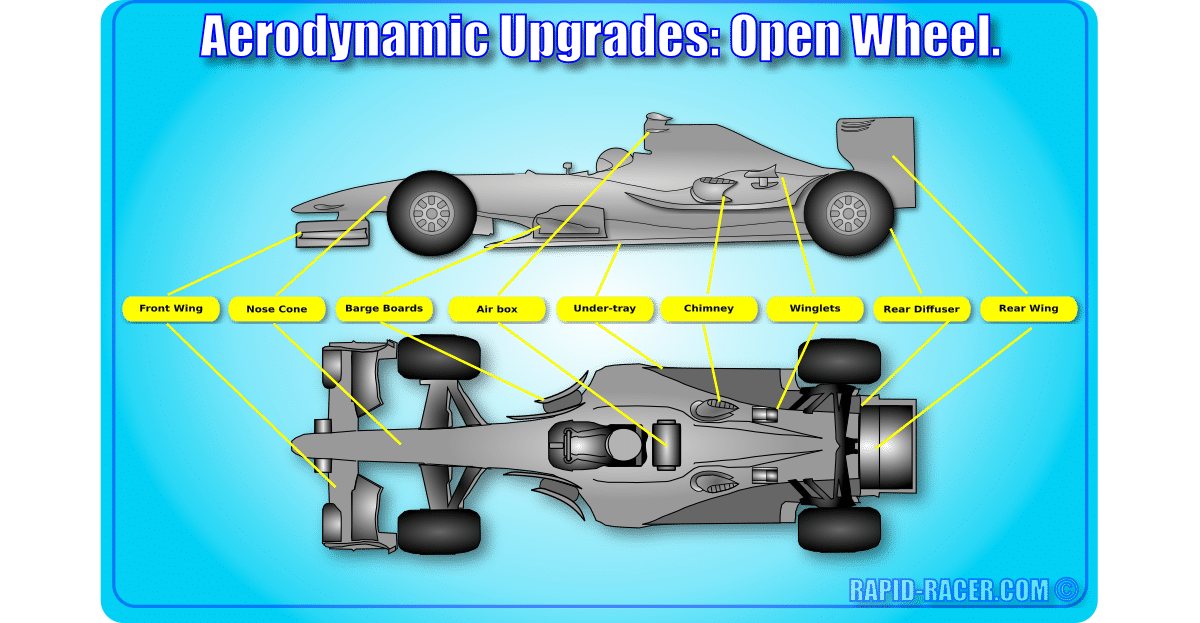
Aerodynamic air boxes are used in open wheel racecar designs, in order to supply air to the intake system of the engine, general aerodynamics of the body and even driver safety.
Important in terms of aerodynamic effectiveness and engine performance. The air box needs to have cold air to feed the engine, which does carry drag penalties to some degree and external design is vitally important.
The whole design centres around “Ram Effect”, which forces air into the air box, the faster you drive, the more air is forced into the device. The air entering the device is forced to enter a small opening, effectively speedy up the air molecules and making them travel faster (low pressure), in order for the air to enter the air box opening. Once air enters the intake, the aerodynamic air box widens in diameter, this has the effect of slowing down the air speed (increasing pressure). The air intake is now more dense, with a higher oxygen ratio, this allows more fuel to be added to the combustion chamber- resulting in increased engine power.

Aerodynamic air boxes are another device which in F1 terms is subject to governing body restrictions. Over the Years the air box has changed and evolved, to include wing-lets and various aero devices. This means that the function of the air box evolves from a way just to feed the engine air, to a down force generating device as well.
As safety has become top priority for drivers, the roll-cage or crash structure is normally incorporated into the design- in the event of the racecar over tuning.
If the overall design has poor aerodynamic efficiency, flow separation could occur, which will have a negative effect on the rear wings´ down force levels and overall drag penalties. This will result in slower lap times due to decrease top speed on the straights, also braking and cornering capacities.
We have seen the overall design change rapidly over the various regulations, especially in F1.
2. Aerodynamic Suspension

Aerodynamic suspension is critical in maximising frontal airflow efficiency to channel smooth airflow to the rear of the car, in open wheel racing cars. Closed wheel racing cars are enveloped by body work and normally closed in under-bodies, so this has less of an effect.
Aerodynamic suspension helps to increase overall down force levels for the whole aerodynamic package. If we have airflow separation at the front of the car, this could easily reduce the whole aerodynamic package, or at least negate some of the down force generation potential.
Aerofoil shaped front wishbone and steering arms help to realise this by keeping laminar airflow in check, while not promoting flow separation, as this will also lead to increased drag levels. The devices take on a side profile of a aero-foil to a certain degree, with minimal drag and smooth laminar airflow as their prime objectives.
Normally constructed from carbon fibre for its light weight and strength proprieties. The lightly increased mass compared to a cylindrical design, is totally overcompensated by the performance gains achieved through better aerodynamic efficiency.
3. Barge Boards and Guide Vanes
Barge boards and guide vanes are used almost extensively in open wheel racing car series. Air which leaves the front of the car can be turbulent, from the front wing, tyres and aerodynamic suspension parts. Barge boards and guide vanes are used to help and direct and channel air in a smooth and laminar manner, to the remaining rearward sections of the racecar.

Vertical or sometimes horizontal plates in design, they are normal mounted within the front suspension or just behind it. These devices were introduced in the 1994 F1 championship, following a mandatory reduction in front end-plate dimension restriction. This left undesired airflow characteristics, which had a negative effect of the aerodynamic package.
Very similar in concept to the front wing end-plate function, the aim was to smooth out and channel turbulent airflow to the rearward aerodynamic devices. By tidying up the front wings assembly's “wake” or dirty airflow, results in less airflow separation, which causes drag- which in turn impacts overall top speed potential. Whiles also impacting the rear aero devices ability to create more downforce.
While this device maybe be small in comparison to other aerodynamic downforce generation devices- we have seen that its impact on the overall package has big benefits.
4. DRS (Drag Reduction System)
A drag reduction system ( DRS) or rear movable wing as some might know it, is a way in which the rear wing's angle of attack can be adjusted for better straight line speed. Essentially a lever which controls one of the rear wing flaps, normally operated during the straights, it's one of the ways in which F1 has adopted new design rules to spice things up in the 2011 season.
The greater the rear wing's angle of attack, the more downforce is generated. By reducing this angle of attack, the wing reduces downforce and drag levels, increasing top speed as a by product and aid overtaking.
In F1 this system is controlled electronically via a FIA approved ECU system and is normally permitted when the leading car is with in a 1 second gap. Speeds of up to 12km per hour are suppose to be the limit of this device, but arguable tracks with more downforce settings could reap larger gains.
5. Nose Cone

The front nose cone, as seen on open wheel designed racecars, are an effective way to mount the front wing and minimise frontal area. While designs in certain race formats may change from season to season, governing bodies have a challenge on their hands reigning in ever more sophisticated design evolution.
While design configuration in nose cone design in its infancy promoted horizontal wing attachment to the sides. The introduction of high mounted design with wings under slung is the universal norm these days. First seen in Tyrrell and Migots of the 1990's F1 Championships.
This design promotes under-tray and rear diffuser airflow optimisation, promoting reduced drag and increase down force potential.
6. Rear Wheel Scallops
Added to the rear of the car, just in front of the rear wheels, scallops help to smooth and channel air to the rear diffuser and around the wheels. Located normally under the winglets, at the end of the side pods.
7. Side Pods
Side pods not only act as a critical housing for the cooling system, including oil and water radiators, but also serve as a life saving safety device. The internal shaping has to maximise thermal transfer rates and reduce drag penalties, which can be a balancing act in its self. But also be a deformable structure to help protect the driver in side collisions.
The design normally incorporates chimneys and cooling louvres help to extract hot air as quickly as possible. Vitally important in hot and humid conditions, especially in F1 where there is no electric cooling fan for the radiator.
General design of the side pods where quite tall and boxy in the beginning, but with ever increasing aerodynamic evolution, modern designs lend to be lower and sleeker. As designers strive for less drag and more down force, at the rear of the car where the biggest gains can be made.
8. Under-tray
Under-trays or under-bodies and underfloor as they are commonly known. Are one of the most important drag and downforce critical aerodynamic components of the whole racecar design especially in racing series such as F1.
Since the discovery of “ground effects”, some 60% of potential down force generation can be achieved with these devices on open wheel racing series- depending on the regulations.
Not actually part of the chassis's structure's strength, it is a full length carbon fibre and mandatory “jabroc” wooden board incorporated aerodynamic device.
The Jabroc wooden board in F1, is checked by scrutineers after races to make sure wear rates are intact, in an aid to reduce team's ride heights and down force generation potentials.
It is mounted to the flat underside of the car to smooth and channel airflow to the rear diffuser. Subject to many rule and regulatory mandates, this device has changed and evolved with many technological advances.
9. Winglets
Winglets are devices which are mounted to sidepods to help to increase downforce generation levels, suited to tight and twisty tracks. Aiding in rear end grip to maximise both cornering forces and traction out of tight corners. Winglets alos have the role of helping to direct and channel airflow over the rest of the Racing car's body and aerodynamic devices.
Closed Wheel Aerodynamic Upgrades

1. Canards

Canards (or dive plates) are small wings which are attached to the front side of the car or bumper in a aid to increase downforce and air flow dynamics. They can also create vortices, these can been normally seen on fighter jets wing tips during flight, resulting in spiralling jets of low pressure air, which aid in reducing drag levels. With car applications, the airflow vortices generated will run along the side of the vehicle in a upwards direction as the car pushes through the air.
Canards are normally only seen on high performance modified road cars or in race series, they will not create huge amounts of downforce levels, but are useful in improving front to rear aerodynamic balance.
They also generate a small amount of downforce by directing airflow upwards over the front of the car aiding in it cutting through the air. Strategically placed, they can also aid in clearing high drag areas on kit cars or even open wheelers racing cars, or by helping to increase aerodynamic efficiency on cars not designed specifically for for Motorsport use and from stock origins.
Canards are normally constructed of Carbon Fibre reinforced plastics, due to its high strength to weight ration. Normally designed in a flat triangle shaped, but sometimes with a curved edge to aid airflow direction. Sometimes supplied in two sets, one smaller and the other larger, the smaller is normally located lower and the larger above.

2. Front Splitter and Air-dam Combination

The main aim of a front splitter and air dam combination is to aid in the optimisation of the flow of air at the front of a car and rearwards to the rest of the body, while reducing drag and creating negative lift (downforce). The main balance is to achieve minimum drag and maximum downforce levels, aiding the front tyres/ tires to get more grip and reduce understeer tendencies.
The front splitter is normally attached to the bottom of the air-dam, which in turn is mounted to the bottom of the front bumper. It serves to increase the amount of downforce at the front of the car. An Air-Dam helps reduce airflow from entering under the front of the car. When used in combination airflow is brought to stagnation above the front splitter by causing an area of high pressure. Airflow under the front splitter, redirects away from this stagnation point and accelerates air under the front of the car, which in turn causes a low pressure zone. High pressure over the splitter and air-dam, and low pressure airflow under the splitter creates downforce by ways of Bernoulli's effect. (high pressure is drawn to low pressure areas).
Another important factor to bear in mind is drag reduction to a certain degree, by having a smooth and contoured front end- this creates a tidier wake as the car punching through the air. This has a net effect on other aerodynamic devices along the rest of the car.
Front Splitters and Air-Dam's helps to minimise the affects of understeer and gives the front end more turn in response on entering corners at speed. Like most racing applications, adjustable angle of attacks maybe possible to adjust for different applications and tracks conditions. This is normally adjusted via an adjustable allen-key set up.
Some bodykits can also generate some degrees of downforce and create a more efficient aerodynamic profile, but some are mostly just cosmetic. Some of the top brands do go through Research and Development and offer a fully functional aerodynamic package. After market manufacture packages are a good example like BMW'S M sports kits, or fitting a higher specification bodykit from with in the same family of vehicle.
In a standard stock car or in modifications for specialist racing series, cars will undergo dynamic development to help increase these downforce levels. Normally lowering the car to a certain ride height level as well as a lower frontal area will help to increase the desired reduced drag and increased downforce requirements.
Also it is generally known that a increase in front down force while entering the “turn in" for a corner will help to combat understeer. This can help to balance a car more and having more grip to maximise steering inputs to hit the apex. letting you come on the power more quickly, producing better lap times.
A front splitter and air dam combination is normally added to help in this situation and can be made from a number of different materials, including fibre glass, carbon fibre and plastics.
3. Gurney Flaps
Developed by Dan Gurney and Bobby Unser, the Gurney flat is a simple but ingenious device. A small flap mounted at normally at a 90 degrees along a wings trailing edge, gives a good downforce increase for tracks where additional grip is required.
A high pressure stagnation point is created as air flows over the top of a wing and hits the Gurney flap leading edge, due to the fact the underside of the wing is hopefully creating low pressure- the net result is more downforce generation.
4. Rear Spoilers

On normal production cars there is a lot of confusion with with a rear wings and spoilers. Spoilers are designed to help the flow of air at the back of the car, but normally don't create positive downforce and are primarily deployed for increased fuel efficiency and reducing lift.
A rear wing is an aerofoil shape, while rear spoilers are normally straight and helps combat the bad flow of air at the rear of the car. This becomes turbulent and a low-pressure zone is created, increasing drag and instability through the Bernouli Effect.Some synergy can be made to spoilers and Vortex generators and the advantages of fitting these devices are similar.
5. Side Skirts

Located between the front wheels and rear wheels on both sides of the cars body, where the seals would normally be positioned. Side skirts are not just cosmetically appearing devices, but are part of an aerodynamic package.
The main goal of side skirts are to help separate areas of low pressure air under the car and higher pressure air around the car. The side skirts become more effective the closer they are located to the ground, with out fouling due to road camber or elevation changes.
Low pressure air generated at the front of the car through aerodynamic devices like front splitters and air-dam, are normally best used in combination with flat underbodies and side skits to maximise downforce generation.
A combinations of materials can be used, but strength and lightness is always key in their applications.
6. Vortex Generators

Vortex generators were firstly developed for the aircraft sector, this technology has made it's way into Motorsport and car design. The main function of this device is to delay air flow separation. Flow separation over the body of the car can result in increased drag and turbulent air which can decrease the efficiency of aerodynamic devices.
Vortex generators are normally small and fit inside the boundary layer, shaped like triangular fins and can be constructed of carbon fibre of other composites and even plastics.
Air flow separation is when the airflow of a object detaches from the surface (boundary layer) and creates eddies and vortexes. This basically means that the car will result in more drag and will reduce top speed and potentially downforce due to the turbulent air entering other aerodynamic device (rear wing for example) and the wake of air left behind the car.
By positioning vortex generator over the rear of the roof, you effectively help to reduce drag and increase downforce via the rear wing. This will have the effect of reducing the overall drag created by the car travelling through the air at speed and the faster and faster you drive the more effect this device will have. Especially effective in speeds in excess of 60 mph (100 KMP) speed ranges.

Aerodynamic Balance
Due to the nature of different drive-line layouts and various weight distribution of the vehicles mass as a result, aerodynamic balance, through the deployment of aerodynamic upgrades, can help to achieve improved handling characteristics.
1. Understeer
In the case of having understeer tendencies, especially at high speeds, we can help eliminate this with the use of front wings, splitters and air-dam combinations. The added benefit of such devices will be the fact that we can adjust the angle-of-attack, to modulate required downforce levels for track conditions and even weight distribution as fuel loads deplete over the course of the race.
2. Oversteer
If we had a car with oversteer tendencies, which increase as speed increases, we can again help to combat this with the use of rear wings or spoilers and diffusers. Again these aerodynamic devices normally have a degree of adjust-ability in order to suit different requirements.
I personally believe that in the future we will see true, active aerodynamic packages centrally controlled by a CPU, resulting in a dynamic downforce levels. Lots of angle of attack for the braking and cornering sections and trimmed levels for the straights.
I am not just talking DRS, which is essentially a lever on the rear wing, but a total system which could include, splitters or front wings, braking and cooling ducts, side skirts, diffusers. We might even see car´s being able to transform its length and width to maximise top speeds and even wheels which produce downforce while rotating.
Sanctioning bodies will no doubt disagree, but that is how I see the Motorsports of the future. What is the point in having Race cars with technology which is not pushing the limits of design. Yes we need racing series to be about the driver and not the machine, otherwise the best engineered car will win. But we could easily harmonize technology at the end of a season to even things up, ready for the next development program. We have seen some pretty crazy experiments over the Years with 6 wheeled F1 cars and Fans mounted at the back of the car- who knows what the future might hold.
Aerodynamic Wings

1. Basic Wing Construction
At its very core the wings used in racing car design, are just like an aeroplane's, but inverted upside down. Lift is generated downwards instead of upwards (covered more in the Downforce section).
Construction can be in a multitude of different materials including aluminium and composites like carbon fibre. Weight and strength are key to their design as the amount of force acting on these devices during operation can be huge and of course exponential with speed.
Wings are normally mounted close to the suspension, or even on the mounts in order to transmit downward loads of force as effectively as possible. Ultimately wings create downforce in order to press the tyres/ tires into the ground and generate higher grip levels. Wings are not spoilers- and they are there to create downforce and not smooth flow separation and reduce drag as their primary function.
2. Front Wings

The main function of the front wing is to aid primarily in Acceleration, Braking and Cornering forces for the Front tyres/ tires and combat understeer. This aids turning ability in fast corners normally above 60 MPH and can amount to up to 25-30% of total downforce generation levels, depending on the regulations for that given season and the design of the racing car.
The front wings especially in F1 and other open-wheeled cars undergo constant modification and race developments due to data gathering from race to race. Adjustments to fine tune the angle of these devices to create less or more downforce is needed to suit each race course. In most series, the wings are even designed for adjustment during the race itself when the car is serviced on a pit stop. Following Driver instruction and tyre/ tire wear considerations or the demands of the race course- dropping fuel loads and unbalanced aerodynamics etc.
These Aerodynaamics Front Wing adjustments are needed to maximise top speed and aerodynamic downforce, especially if a racing car is fully loaded with fuel at the beginning of a race. The car will be lower to the ground, as the race progresses and more and more fuel is consumed. The car will slowly raise it's ride height at the front, normally creating understeer. Adjustable front wings, helps to counter act this troublesome problem and the associated handling imbalances this might cause. As mentioned normally dialled in during pit-stops.
Another problem engineers face is the fact that front wings are designed to function properly with clean undisturbed air, in F1 for example teams have struggled in recent years with this problem. When the car behind has decreased downforce levels when following a lead car. This reduced downforce and associated drag is good for slip streaming and top speed, but totally unsettles the car for fast sweeping corners. Figures suggest that this could be up to 70% reduction at a distance of 20m behind the lead car.

The basic design of a front wing has evolved over the years, but is generally an aerofoil suspended from the from nose cone, with movable flaps incorporated in the design to adjust for the angle-of-attack (downforce settings). There can be multiple stacks of these wings in different sections, further increases their complexities, End plates are normally also mounted at either end of the wing to help the airflow to be forced over or under the wing- further increasing its efficiency. Also this helps to combat with the turbulences generated by the front wheels. The design of the front wing is critical in controlling the flow of air over the rest of the car and is constantly being refined in a given race series to yield a competitive edge over the competition. Any aerodynamic issues at the front of the car has an impact on the rear of the car, so it is critical to get this right in the beginning.
3. Rear Wings
The main function of the rear wing is to aid primarily in Acceleration, Braking and Cornering forces for the Rear tyres/ tires and combat oversteer.

The flow of air at the rear of the car can be affected by many different influences and generally does not have clean airflow. This causes the rear wing to be less aerodynamically efficient than the front wing, due to the disbursed airflow from the front of the vehicle. But typically it must generate more than twice as much downforce as the front wings in order to maintain the handling balance of the car, but this depend on the type of racing car and it's application. A larger aspect ratio or angle of attack, would be seen compared to the front of the car and often uses two or more sections- stacked on top of each other. In an aid to create the amount of downforce needed and maximise available space.
In car designs with the power being delivered via the rear wheels, this is especially vital and the rear wing will not only add acceleration and braking abilities, but also cornering grip. Generally speaking, when the aim of top speed is the main consideration, race engineers will reduce the angle of attack to minimise drag. Also on some designs, rear wing construction are less pronounced then on F1 for example, due to the need for a more slippery design and top-speed goals.

The rear wing can typically have adjustability just like the front wings, each of these can often be adjusted when the car is in the pit stop via small Allen keys to adjust the required downforce levels. F1 DRS (Drag reduction System), has electronic actuators which levelled off the angle- of attacks, for the rear wings to reduce downforce and drag- thus increasing top speeds- which is actually operated while driving.
In the future the idea of active aerodynamic devices will probably raise their heads again and having the ability of these all these devises to adjust on the go via computer calculations, would yield huge performance gains compared to most static set-ups requiring adjustments. This would help to increase fuel economy, while giving maximum performance levels for road car applications.
4. Wing End-plates

Wing end-plates help to increase the effectiveness of the rear aerodynamic parts. Helping to make sure airflow is ducted to the rear wing and doesn't spill over the sides, while reducing drag. Rear wing end-plates effectively make the wing span operate, as if the span was a lot bigger- while retaining a more compact design.
To increase front wing efficiency and maximise performance, the end-plates stop air spilling over the component and control airflow. Situated at the side of the wings, these devices help to channel the air at the front of the vehicle and maximise the wings effectiveness. The rearward airflow coming of the device is smoothed out and helps to increase other aerodynamic devices efficiency. Including both racecar under-trays and rear diffusers, benefiting towards a complete “aero package”.
You might be saying “what is the effect on drag”. Front wings and front wing end-plates have a surprisingly minimal effect on drag for the whole aerodynamic design, unlike small changes at the rear of the car, which can have drag penalties- due to the wake being altered.
To increase front wing efficiency and maximise performance, the end-plates stop air spilling over the component and control airflow. Situated at the side of the wings, these devices help to channel the air at the front of the vehicle and maximise the wings effectiveness. The rearward airflow coming of the device is smoothed out and helps to increase other aerodynamic devices efficiency. Including both racecar under-trays and rear diffusers, benefiting towards a complete “aero package”.
You might be saying “what is the effect on drag”. Front wings and front wing end-plates have a surprisingly minimal effect on drag for the whole aero design, unlike small changes at the rear of the car, which can have drag penalties.
Chassis and Under-body Aerodynamics

While largely hidden from view, chassis and under-body aerodynamics are the secret weapons in an arsenal of aerodynamic features for generating downforce on racing cars. The under-bodies are designed to slice through the air and minimize wind resistance or drag- while also reducing drag levels. While not as visually apparent- some 60% of total racing car aerodynamic downforce could be generated in some applications.
Even in every day driving having an aerodynamic flat under-body could still be desirable, helping keep your fuel/gas bills down as well as provide a better top speed- so this is not just a racing application. If you can imagine all the nooks and cranny's normally expose on a cars under-body, by creating a smooth boxed in undertray, drag can be greatly reduced. Maximisation of a cars aerodynamic potential can be achieved with these along with the other aerodynamic devices such as diffusers and side skirts.
Detailed pieces of bodywork can be engineered to allow a smooth air flow to reach the downforce creating elements, as well as actually being a negative lift generating device in itself.

In recent times more and more work has been undertaken on the underside of the body, similar in shape to an inverted wing. First used by Colin Chapman's Ground Effects racing cars- an inverted- wing shape was located in the side pod's. Open wheel racing cars ultimately had this banned by governing bodies- as some racing serials dictate a purely flat underbody on some sections of the car. Closed wheel applications are some what different, but use the same principles of a inverted-wing.
The main principal works by the front of the car (splitter/ airdam for example) creating low pressure fast moving airflow to the underbody of the car. As airflow is forced to travel through a restricted space (the body work of the car and the ground)- it increases velocity and drops in air pressure. The difference of the higher ambient air pressure and this low pressure, under the car- creates downforce and the car is sucked to the ground. The faster you drive, the more downforce is produced, exponentially as speed is inceased.
Airflow can then travel the length of the under-body and may even pass through a front-diffuser, again re-energising the airflows natural tendency to return to ambient pressures. During the flow rearwards, side-skirts can be deployed to help separate the low and high pressure air at the sides of the car, helping to increase efficiency. Rubber skirting, which moves with the road level could be deployed, but makes downforce generation very reliant on speed, also very inconsistent with sudden camber elevation changes. Another option would be to have airflow tunnels shaped either side of the driveline and gearbox , which could also help to keep low pressure airflow intact with out side skirts in place.
As we work to the rear of the car- we can then come across the rear diffuser and its air channels- which creates a expansion area. Airflow is made to slow down as it exits the rear of the car and return to ambient air pressures. This not only helps create downforce via the diffuser, but also reduce flow separation and produces a cleaner wake at the rear of the vehicle. The net effect of this is less drag as an added as a result creating additional downforce as a bonus.
Because the slowed airflow is achieved by creating an expansion area- a vacuum effect is generated (a giant venturis, high pressure air presses down on low pressure air). Airflow has to accelerate over the diffuser in order to fill the expansion area, before being slowed, creating downforce- smoothing out the airflow at the back of the car, reducing drag and improving aerodynamic efficiency.
Diffuser and Exhaust Gases

A diffuser is a aerodynamic device located on the under-side of a road or racing car. Normally diffusers are situated at the rear of the car (rear diffuser), but can also be incorporated into racing car designs at the front of the car (front diffuser). Construction is normally from carbon fibre or other composites to minimise weight while keeping strength.
The diffuser has a lot of jobs to do, firstly it acts as a way of speeding up airflow entering the device (lowering pressure), and then slowing down airflow (increasing pressure). This is by means of the venturi effect., effectively sucking air through the device. While doing this it also has to make sure that flow separation does not occur, resulting in stalled and turbulent airflow- in other words lots of drag. This can be achieved by have a gradual gradient and volumetric increase along the body of the diffuser.

Airflow entering the diffuser has to expand to fill the expansion chamber of the device (void), this forces more air to enter the mouth, creating even more low-pressure airflow and downforce- with a vacuum effect. Downforce is at its highest peak at the mouth of the diffuser entrance and raises in pressure going towards the exit of the device.
Airflow exiting the diffuser has to match the outside high pressure air, this has an effect of reducing pressure induced drag. Smoothing out turbulent air exiting the the rear of the car and matching the outside high pressure air while minimising drag is critical. In order to make the the device as efficient as possible and keeping the downforce/ drag ratio in a positive position. The actual amount of increasing gradual pressure produced after the entrance of the diffuser, is not to create lift and is still lower than ambient pressure- until actually exiting the rear of the device.
As the diffuser has minimal drag penalties compared to other aerodynamic devices, it is a very efficient for downforce generation. It works especially well with a rear wing and its best deployed with flat or enclosed under-body designed cars. It is also possible to incorporate a inverted wing into the exit of a diffuser as well, this creates even more low-pressure downforce generation. Another option is to have a double deck diffuser, further increasing downforce generation capacities.
1. Rear Diffuser and Exhaust Gases

The faster you drive a car's with diffusers deployed, the more downforce is generated- in turn the move the engine works the more exhaust gases are produced. Clever engineers thought to use this unproductive waste by-product in a way to help drive the venturi effect. Exhaust gases in its nature is hot and turbulent and open wheel racing cars like F1 have harnessed this to their advantage.
By incorporating the exhaust system into the rear diffuser, you can also help extract the air from the rear of the car more effectively. The exhaust gasses produced effectively energise the airflow, helping to raise the low pressure air the diffuser creates by amplifying the suction effect. This fast moving air flow returning back to the ambient atmospheric pressure at the exit of the diffuser, reducing drag levels. Hot exhaust gases also aid in expansion, again aiding in the airflow speed transition between fast moving underbody air and slow moving ambient air. Resulting in higher vacuum effect, more downforce and reduced drag.
The diffuser is rather sensitive to engine speed when blown by exhaust gases, so if the driver lifts off the throttle, lose of downforce is experienced (as a result of speed and exhaust gases). The exhaust flow is greatly reduced off throttle and makes the diffuser less effective, robbing the downforce generation effect. This can cause handling issue where the rear of the car might become twitchy and prone to more lift off oversteer ,on throttle release. Engine mapping can overcome this by pumping more air out even when off throttle.
Rear and front diffuser design is evolving constantly and some application don't even require the exhaust system integration to yield big beneficial downforce levels. Also you might of noticed earlier Super-cars of the 80's always had big rear wings to generate downforce, but modern designs can generate sufficient required levels without such devices.

