Tyres/ Tires and wheels should be viewed as the most important Performance Upgrade, not only do they affect the Cornering Grip, but also Braking and Acceleration abilities. Ultimately a road or race car is a combination of various components, designed to maximise the tyres contact patch with the ground.
You could spent thousands on upgraded braking systems, complex suspension components or more horsepower, but with out the mechanical grip- these could end up being a waste of resources to maximise your Upgrade efficiency, so it is always best to start from the ground up.
A prime example of this is the correct tyre/tire choice used for a race series, weather conditions could play a major factor, or even wear rates to track conditions- this is recent Years has been one of the major strategies used in F1 to cause some upheaval in the field for certain races, with surprise wins.
Tyre/Tire Construction
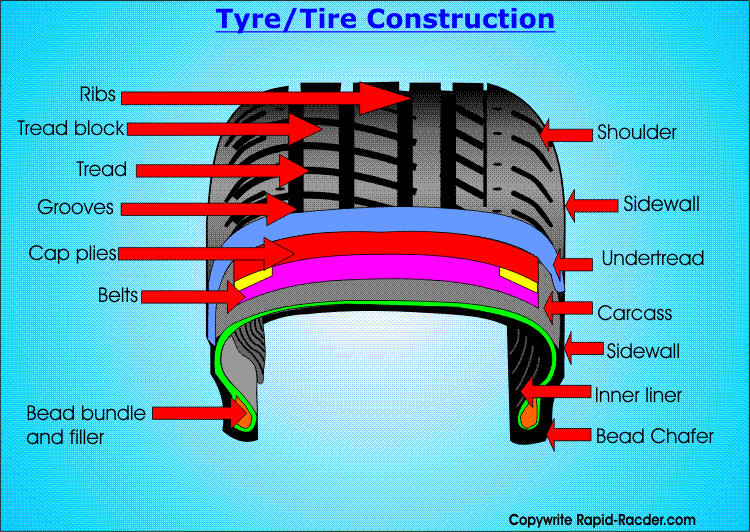
Modern day tyres/tires comprise of a combination of Rubber, compound materials and other chemicals to aid in the construction. The tyre/tire normally consist of the sidewall (makes contact with the wheels through the bead) and main body with the tread pattern (makes contact with the ground through the contact patch).
Tread patterns can vary depending on driving conditions and may even include studs for snow driving. While a tread pattern with less grooves will provide more mechanical grip, such in Slick Racing tyre/tires. A pattern with grooves are required when you introduce water/slippery surfaces into the equation to help the tyre/tire cut through the water and make contact with the road helping to stop aquaplaning. As with most components on a car, special tyre/tire designs are available from a range of manufactures to suit determined applications.
Rubber used in tyre/tire construction can also vary between hard and soft compounds. Hard tyre/tire compounds will normally yield higher wear rates and would be ideal for endurance racing, but will normally have lower overall grip levels. While softer tyre compounds sacrifice wear rates for ultimate grip levels.
Depending on the exact tyre construction, the purpose for use and different ratings of the Road/Race tyres varies considerably. So it is best to go through the basic to understand how they work.
Tyre/Tire Care
Tyre care is critical for any competitive edge in motor racing, there is no point in being the fastest car on the track, until the last few laps, then tyres lose all traction and the rest of the field pass you.
Just like good maintain schedules on other components of the vehicle, we have to look after the tyres to get maximum traction for the longest amount of time.
Race tyres and street tyres can vary in the way that they perform on the racetrack or on the road, but they also share some methods to ensure that they are looked after.
TYRE/TIRE CARE CHECK LIST
Time
When a tyre is first manufactured, it is normally at its greatest performance potential (some tyres need breaking in or scrubbing) and especially true for race tyres. As a tyre ages, the chemical compounds and rubber start to deteriorate, meaning race tyres designed for qualifying, may only last a few laps. Other environmental effects also play their part on acceleration the tyre's lifespan.
Ultra Violet Light
U.V light from sunlight has a negative effect on the rubber and chemical compounds present on tyres. In the case of race tyres, if you have the budget to throw away used or partially worn tyres after each race session, then you have nothing to worry about. If this is not the case, then tyres need to be covered from the sunlight to retain maximum performance.
Street tyres on your road car have different chemical compounds, within the rubber and do not suffer as much from this problem. But their performance potential is also a lower levels then dedicated racing tyres. If you have semi slick race tyres for track days, get two sets of wheels and keep the tyres for the circuit only.
Debris
Hot rubber and debris can be a big problem, if you have to drive through the paddocks with a set of tyres you will be reusing, the heated tyres will pick up all sorts of rubbish on them. This could includes, stones, oil, petrol (gas), safety wire and even rubber from other tyres. This will have a negative effect on tyre performance, for when you want to use them again. Keeping tyres free of debris also reduces the chances of a puncture, so clean them off after use, if they are to be used on another occasion.
Heat Cycles
While this might not be an issue if you have the budget for new tyres at every race session, the act of heating up and cooling down a tyre will eventually have an effect on the tyre structural strength. This may not be much of an issue with street tyres, as you will be operating in a safe heat zone and not maximising tyre traction capacities. But if street tyres are used for track days or circuit driving, this will become an ever increasing issue.
Flat Spots
If you have race tyres which are used just on the race track, leaving them on a vehicle when being stored will have a negative effect on the tyre. If possible keep a used or worn set to store the vehicle on, saving good rubber, flat spot free for when you need them.
Leaks
When using race tyres for circuit driving, it is normally wise to check tyre pressure an hour before an event and also half an hour later, to make sure you do not have a puncture.
Tyre Coefficient of Friction
A tyres coefficient of friction (or CF) is a number which can be used in comparing different levels of pneumatic grip, tyres may have as a result of the molecular bonding between the tarmac and rubber compounds of their construction and the forces acting upon the tyre. In order for a tyre to produce grip, the tiny molecular structures of rubber make contact with the road surface and need to be sheared to produce grip.
This force the tyre generates can be both longitudinal and lateral in nature, at times it can even be a combination of the forces. A tyre with a CF of 1 will yield equal grip levels proportionate to the loads and forces acted upon it. A tyre with a CF of 1.5 will generate more grip levels than the load or forces acted upon it. From a performance point of view, we want to have a tyre with a larger CF figure, to increase accelerating, braking and cornering capacities.
You may of been under the impression that a stationary tyre yields all its grip just sitting there, but as you will find out, there are different factors involved, which affects a tyres ability to attain maximum grip levels.
Maximum Tyre Grip
Essentially this CF number values attached to a tyre, gives a indication of a tyre´s grip levels, compared to others , if all of the optimum values above were constant. A tyre with a CF value of one, would be able to convert 100 KG of vertical down force into usable force. A 1:1 ration in this case, likewise a CF value of 1.5 for a tyre would have a 1:1.5 ratio.
It is important to realise that even if we did have a tyre with a CF level of 1.5, this does not automatically mean the tyre will be able to generate 1.5g in the corner, or under accelerating or braking. The CF figure combined with different variables, could be used to help calculate the performance potential of a tyre.
Variables, Affecting CF in Tyres
This list is far from all inclusive and there are many variables which affects a tyre's grip generating capacities.
Tyre Download Effect on Traction and CF Levels
The harder the tyre pressures down on the road surface, the more grip is produced. This is why down force has played such an important role in modern racing car design.
We must separate CF levels and traction levels in our mind to under stand the relationship between them and tyre downloads rates.
We can see that as download on a tyre increases, so does traction levels, as more and more download is applied to a tyre. As we reach higher download levels, the rate at which traction increases reduces, in percentage terms, but it still does increase. This will keep increasing until we reach the ultimate CF of a tyres design limitations, we could see a tyre ripping themselves apart once its limitations are exceeded.
When we look at the tyres CF levels we can see that the opposite is true, in that as we apply more download levels to the tyre, its CF reduces. As the traction curve is steeper for traction increases than the gradual reduction of CF levels, ultimately we get a increase in traction levels.
This is why light weight cars are capable of producing higher lateral and longitudinal forces than cars with higher masses, fitted with similar tyres. Also we can now see why designers and engineers produce race cars with low CG (centre of gravity) and RC (roll centres), minimising inside tyre to outside tyre load transfers in cornering.
Increases in lateral load transfer in cornering results in reduced CF levels for the outside tyres, this will result in less overall traction and grip. Reducing cornering speeds. Ideally we want the tyres to share as much of the cornering loads as possible, to aid in a balanced and maximised handling package.
Vertical or Normal Loads
Vertical or (normal loads is the amount of download acting on a tyre a any given moment and can be dynamic in nature. It is normally represented by pounds or kilograms as a measurement. Both vehicle weight and aerodynamic down force can contribute to this total load rates.
Depending on load transfer from acceleration, braking and cornering forces and down force levels at given speeds, you can have different downloads on different tyres. This can be at the front or rear axles or even the left and right wheels on an axle.
The tyre´s CF (coefficient of friction) actually gradually decreases as loads increase, but the overall traction of a tyre increase at a faster gradient. That is why down force generation is worthwhile, especially in lighter weight cars which can produce higher cornering forces that larger mass vehicle, given the same tyres.
Ultimately the tyre will be the critical factor in determining grip levels from vertical load rates. Accelerating, braking and cornering capacities will all increase with higher vertical load rates.
Vertical or Normal Loads Effect on Traction
Equal Load Shift | Effect |
|---|---|
Increased Front Load: | Increased Braking Efficiency. |
Increased Back Load: | Increase Acceleration Efficiency. |
Increased Loads All Corners: | Increased Cornering Efficiency. |
Traction Circle
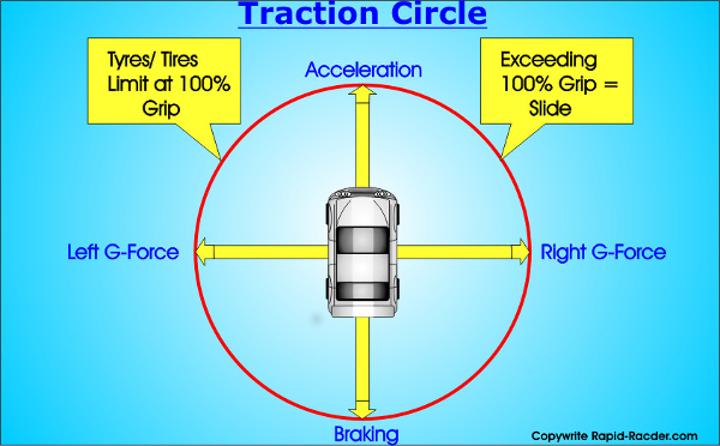
The Traction Circle is a dynamic way in which the car's tyres (tires) interacts with the road surface when driving. It is a easy way of teaching people the limits of the tyres on the road and track, which ultimately determines the overall performance of a car's current limits.
If you imagine the circle above which is divided between the cornering G-Forces of the tyre (left to right) and the braking and accelerating forces (bottom to top). You can see that a car can only perform 100% of each required force. Under normal driving conditions it could be a combination of two at a time. For example if you were to brake while turning into a left hand corner, you might be using 80% braking force and have 20% left lateral force to turn the car.
This traction circle helps explains why if your using 100% of braking force to slow the car, the tyres will have no remaining traction to turn the car for a corner. Traditional race-craft teachings have suggested that you get your braking done in a straight line, use maximum G-force to turn in to hitting the apex, then accelerate away. But this is not normally the case and gentle transition from one phase into the other is normally the best technique, using a combination of the forces involved. Then again it comes done to the road or track conditions, the vehicle being used and the style of the driving applied.
When 100% grip is exceeded while driving, the tyres will slip and begin to slide. This could be the desired effect for drifting when using a combination of Left/Right G-force and the throttle pedal, but these cars are normally set up to react well to exceeding the limit. A highly strung racecar, entering a corner too hot might have a more violent reactions and snap into a spin. With you ending up on the gravel, or worst still embedded in a crash barrier.
On another note understeer, oversteer and neutral handling are three characteristics experienced during load transfers and for simplicity. I would like to set an example to help explain them. But bear in mind due to the diverse nature of the drive line set ups and various engine power delivery in different design configurations, some cars will act differently then others.
Imagine for a second you were in a deserted car park or skid pad, with no people around and no obstacles to hit. If you had a constant speed of say 30 mph in a constant radius circle, with say the steering wheel at quarter lock to the Right. Hopefully the car would hold the line and this wouldn't use too much of the available car's grip limit. While driving, we mentioned that there are three states in this situation, Natural, Understeer and Oversteer handling.
Slip Angle
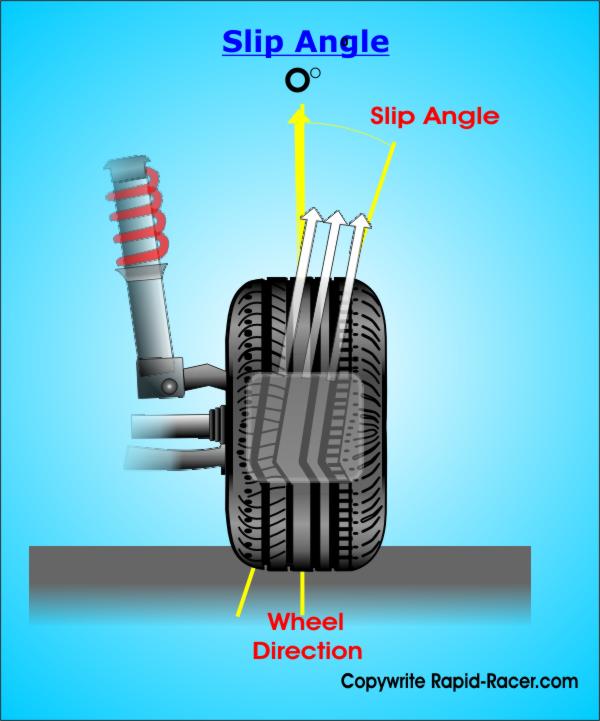
Tyre slip angle is the direction the wheel is pointing towards versus the directional travel of the tyre, the difference in this angle is the slip angle generated by the tyre. This is not related to the wheels steering angle. Slip angles need to be generated in order to achieve maximum cornering forces.
Due to the fact the tyre is made of rubber, the elasticity of the material bends and stretches under different acceleration, braking and cornering forces. It is the rubber´s material properties which can generate more force than is downloaded into the tyres. It is a combination of elastic and sliding forces generating additional cornering forces. That is evident if a tyre has a CF (coefficient of friction) greater than 1 for example. Slip angle refers to the cornering forces the tyre experiences, while slip ration is the forces the tyre under acceleration and braking.
Slip angles in tyres might seem like a negative situation from a performance point of view at first glance, but the tyre actually has increased levels of grip with a increase in the slip angle compared to no slip angles present. There is also an increased in CF (coefficient of friction) of the tyre. These levels will continue to rise up to the tyres optimum slip angle range, past this slip angle range, grip and CF starts to drop off. After this point the rubber will give up some of it's adhesion properties (elasticity) and begin to slide, resulting in a lower overall percentage of grip available for cornering forces. Even when the tyre has exceeded the optimum slip angle, substantial cornering forces will still be present.
Normally a narrower and taller tyre will have a larger slip angle peak (larger aspect ratio), while wider and lower designs, will have less slip angle ranges (lower aspect ratio). It is also important to note that street tyres generally have larger slip angles then racing tyres. Street tyres peak grip levels will also decrease more rapidly pass the optimum slip angle level, compared to racing tyres.
It is not just the front tyres through steering inputs which are subjected to slip angles, the rear tyres also generated their own slip angles. In fact any loads in a lateral plane will act on a tyre and create a slip angle of some degree.
Racing Tyres and Slip Angles
Racing tyres have smaller slip angles for a number of reason, firstly it the aspect ration of the tyre itself which determine the actual angle. It is well known that racing tyres will have more grip capacity and CF than street tyres. Driving will big yaw angle through corner may look good, but in fact it is extremely slow for lap times.
Secondly, low slip angles generate less heat, apart from the initial heat required to get the tyre up to the correct temperatures, additional heat is wasted power, wear the tyres out more quickly and do nothing for performance levels. Normally racing tyres operate in limited temperature ranges, by having a lower slip angle, the heat can be more easily controlled and this also heats the tyre thermal efficiency. Lower thermal efficiency, means you can run softer compound rubber for longer will out huge wear rates. The softer the tyre compound you use, the more overall grip and increased performance is available.
Slip Ratio
Slip ratio (known as percentage slip also) is the longitudinal forces acted on a tyre through braking or acceleration forces. Similar in respect to slip angles, which deal with lateral or cornering forces. The same elastic and sliding forces on the tyre´s rubber, is created through the molecular compound of the tyre and road surface.
Maximum braking and accelerating traction is achieved at a given slip ratio, as the CF (coefficient of friction) also increases with this rise. Once we reach the optimum slip ratio, the overall grip levels will start to drop. That is not to say all braking or acceleration forces are lost, but at a lower than maximum capacity.
Slip Ratio and Braking
As we increase the braking pressure, approaching a corner for example, the wheel will reduce in its rotational movement, optimum braking is normally achieved at at 15% slip ratio, than if the tyre was moving freely. Once we exceed this amount the tyre will begin to lock up, with no rotation to wheel. We will reduce maximum traction potential and it will take longer to stop.
Once the wheel locks up and we exceed 15% slip ratio, the overall grip levels of the tyre can reduce between 30%-40%. A few other negative effects also occur:
Slip Ratio and Acceleration
During acceleration, the tyre is affected by slip ratio, maximum traction can not be achieved unless some slip ratio is present. Below optimum slip ratio, we has less grip and once we exceed this limitation of the tyre, we will see a further reduction in overall grip. We know that we have exceeded the optimum slip ratio when the tyre begins to wheel spin. We will still get some accelerating forces acting through the tyre when we exceed the optimum slip ration, but grip levels will not be maximised. Negative affects resulting from wheel spin:
Side Wall Coding
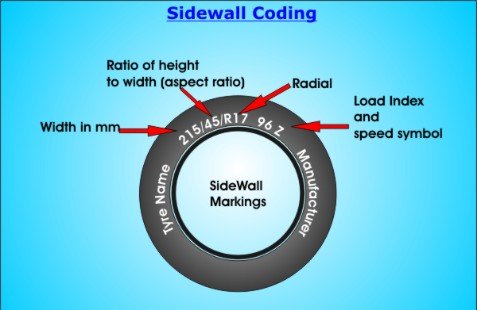
We will be looking at at wet and dry (all weather) tyre applications for now to get a understanding of how tyres compare to each other. If you look at your tyre sidewall, then you will see a serial of numbers on the side. Lets quickly run through what all the numbers mean.
The first number in the sidewall coding diagram refers to the width of the tyre (contact patch on the floor), the second number is the aspect ration of the tyre and the third is the diameter of the wheel. We then have the load and speed index figures.
Tyre Load Index
Each tyre has a load index rating, indicating how much weight it can take, this shouldn't really be a issue as you want to be losing weight not gaining it. But again make sure you have the right rubber for the job as specified by the manufacturer:
Load Index | Load in kg | Load Index | Load in kg |
|---|---|---|---|
62 | 265 | 94 | 670 |
63 | 272 | 95 | 690 |
64 | 280 | 96 | 710 |
65 | 290 | 97 | 730 |
66 | 300 | 98 | 750 |
67 | 307 | 99 | 775 |
68 | 315 | 100 | 800 |
69 | 325 | 101 | 825 |
70 | 335 | 102 | 850 |
71 | 345 | 103 | 875 |
72 | 355 | 104 | 900 |
73 | 365 | 105 | 925 |
74 | 375 | 106 | 950 |
75 | 387 | 107 | 975 |
76 | 400 | 108 | 1000 |
77 | 412 | 109 | 1030 |
78 | 425 | 110 | 1060 |
79 | 437 | 111 | 1090 |
80 | 450 | 112 | 1120 |
81 | 462 | 113 | 1150 |
82 | 475 | 114 | 1180 |
83 | 487 | 115 | 1215 |
84 | 500 | 116 | 1250 |
85 | 515 | 117 | 1285 |
86 | 530 | 118 | 1320 |
87 | 545 | 119 | 1360 |
88 | 560 | 120 | 1400 |
89 | 580 | 121 | 1450 |
90 | 600 | 122 | 1500 |
91 | 615 | 123 | 1550 |
92 | 630 | 124 | 1600 |
93 | 650 | 125 | 1650 |
Load Index | Load in kg |
|---|---|
62 | 265 |
63 | 272 |
64 | 280 |
65 | 290 |
66 | 300 |
67 | 307 |
68 | 315 |
69 | 325 |
70 | 335 |
71 | 345 |
72 | 355 |
73 | 365 |
74 | 375 |
75 | 387 |
76 | 400 |
77 | 412 |
78 | 425 |
79 | 437 |
80 | 450 |
81 | 462 |
82 | 475 |
83 | 487 |
84 | 500 |
85 | 515 |
86 | 530 |
87 | 545 |
88 | 560 |
89 | 580 |
90 | 600 |
91 | 615 |
92 | 630 |
93 | 650 |
94 | 670 |
95 | 690 |
96 | 710 |
97 | 730 |
98 | 750 |
991 | 775 |
100 | 800 |
101 | 825 |
102 | 850 |
103 | 875 |
104 | 900 |
105 | 925 |
106 | 950 |
107 | 975 |
108 | 1000 |
109 | 1030 |
110 | 1060 |
111 | 1090 |
112 | 1120 |
113 | 1150 |
114 | 1180 |
115 | 1215 |
116 | 1250 |
117 | 1285 |
118 | 1320 |
119 | 1360 |
120 | 1400 |
121 | 1450 |
122 | 1500 |
123 | 1550 |
124 | 1600 |
125 | 1650 |
Tyre Speed Rating
As the same suggest, each tyre´s speed rating number code relates to a specified speed rating of the tyre, careful consideration needs to be taken into account when you upgrade your choice of rubber. Especially if aerodynamic and engine modification in on the agenda.
Having a incorrect speed rating for your newly upgraded car could have serious consequences, especially if the tyre is not capable of the new founded top speed, or lateral G-Forces generated in the corners. The last thing you want is a high speed blow out, so make sure you have the right rubber for the job. Have a look at the table below to check you have it covered:
Speed Rating | MPH | KMPH |
|---|---|---|
N | 87 | 140 |
P | 93 | 150 |
Q | 99 | 160 |
R | 106 | 170 |
S | 112 | 180 |
T | 118 | 190 |
U | 124 | 200 |
H | 130 | 210 |
V | 149 | 230 |
Z | 150+ | 240+ |
W | 168 | 270 |
Y | 187 | 300 |
